Where the SaaS panic is justified, and where it is overdone
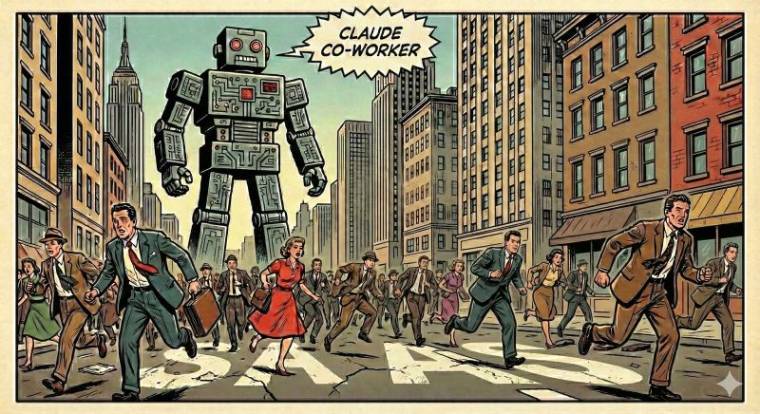
In recent days investors have been fleeing SaaS stocks in the public market. The AI threat became tangible, especially after users started sharing real experiences with Anthropic's coworker. What looked futuristic not long ago suddenly feels like a direct threat to a large share of existing SaaS models.
The market's reaction is less interesting than the question of what exactly broke.
Over the years, SaaS companies built market leadership and meaningful premiums when they held at least one of three core advantages:
1. Companies that won through adoption and growth. Products that are easy to bring into an organization, with low friction and mechanics that expand usage. Land and expand proved extremely scalable, and the market rewarded it with a premium.
2. Companies that built products that are hard and expensive to replace. Once inside an organization, churn was very low. Over time they added capabilities, and the captive customers paid more and more. Here the premium came from the dependency the organization developed.
3. Companies that created a unique, differentiated value proposition. A clear edge over the competition and a quality brand that allowed high prices and impressive margins.
These three models represent different sources of competitive advantage. Then AI enters and shakes the assumptions they were built on.
Where is the panic justified? Mainly where the advantage rested on momentum rather than structural power. In three places: companies whose edge relies mostly on a thin application layer and UX, which becomes easier to copy and easier to replace; companies that won mainly through growth speed, because when every company can grow faster with AI, an advantage based on speed alone becomes especially fragile; and companies that raised prices without deepening value, because the model AI brings, pricing on value and outcomes rather than subscriptions and seats, directly threatens pricing that rests on inertia.
Where is the panic possibly overdone? Also in three places: companies that became the system of record, where organizational knowledge is stored, workflows are built, and tribal knowledge lives, because the deeper they are embedded, the more their value to the organization grows; companies with network effects that depend on connectivity and their customer base; and companies that created unique data and tied it to meaningful customer value. Not just large data, but data created through unique activity, over time, under conditions that are hard or impossible to reproduce. Some are even in pole position to exploit AI capabilities on top of the data they already hold.
To understand who is truly vulnerable and who is less so, it is not enough to ask whether a product is easy to replace. You have to ask where its competitive advantage comes from. This is exactly where Hamilton Helmer's 7 Powers model comes in, focused on the fundamentals that explain which competitive forces create durable advantage.
Unlike the previous decade, you cannot grow fast first and crack the moat later. The panic does not hit all companies equally, because not all competitive advantages were built from the same source.
This is no longer a theoretical conversation. Existing companies that crack it will flourish, and new founders who arrive with the right combination of strategy and execution will replace part of the existing SaaS world. And for us as investors, it is a once-in-a-generation opportunity to build, with founders, the companies that will define the coming decades.