Show Me the Flywheel
Larry Ellison says data is the resource that decides the AI era. That is becoming the consensus. It is right, and it is only half the picture.
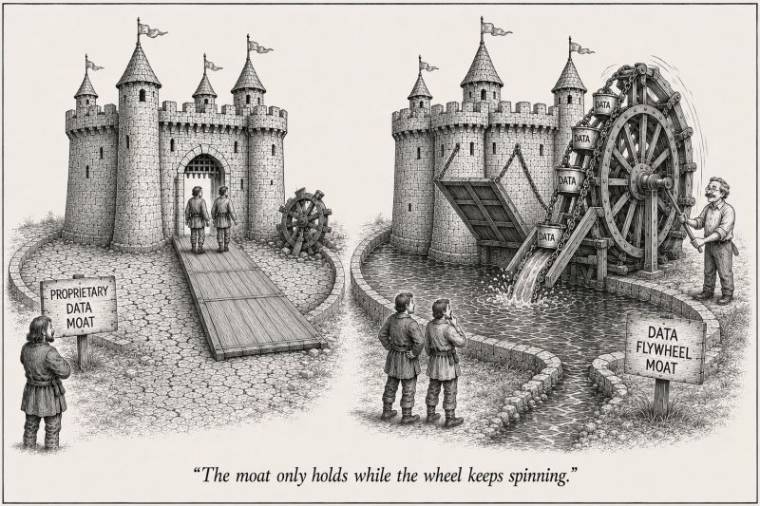
Proprietary data is a head start, not a moat. A head start depreciates the day a better model ships. What survives model turnover is not the dataset you hold. It is the loop that keeps making the dataset better.
A moat is proprietary data that compounds. That loop is the data flywheel.
A great flywheel has a clear shape. The cost of adding one more data point keeps dropping, while the value of each new point keeps growing. The more data you hold, the more value the customer gets, and the easier it becomes to gather the next point. Usage sharpens the system, and the sharpened system attracts more usage.
Most founders do not start with a backpack full of data no one else has. The dataset has to be built. Across the companies we partnered with from their first days, five patterns actually worked.
Earn it intimately, one customer at a time. Navina, an AI copilot for primary-care doctors, helped physicians treat patients better. Practice by practice, that trust earned access to years of medical records, and every new customer made the models sharper. The data was never for sale. It was earned.
Go where no one else is willing to go. Alice spent years in the darkest corners of the internet building what it calls the world's largest store of adversarial intelligence. Knowing how real harm operates is what lets it protect billions of users and the largest AI models. The barrier was never technical. It was willingness.
Capture the physical world no one bothered to digitize. Limitless Labs went to the factory floor and gathered the real CNC machining data that lived nowhere else, then trained physics-based AI on it. The dataset did not exist in any cloud because the industry never put it there.
Harvest the public signal at a scale no one else reaches. OnFire built the engine to read the open web where customers reveal what they want, and turns millions of scattered signals into who is buying what, and when. The raw material is public. The structure is proprietary.
Create data that never existed. Protai used proteomics to map disease at the protein level and built the largest, most diverse proteomic database in the world. Not collected. Created.
Notice what these have in common. None of them stopped at owning the data. Each spun its dataset into a flywheel, cheaper to feed and more valuable with every turn. The flywheel, not the data, is what becomes the moat.
There is a second thing worth noticing. The strongest data strategies were articulated before the first line of code. Navina's founders told me in our first meeting that they knew how to build AI systems, and that they would not write code for a year until the data strategy was precise. That was not a slogan. It became the company's durable advantage.
So when an AI company tells you its data is proprietary, that is the beginning of the conversation, not the end. Proprietary alone is a countdown. Proprietary plus a flywheel is a moat.
There is one real question to ask. Does it compound.
Show me the flywheel.